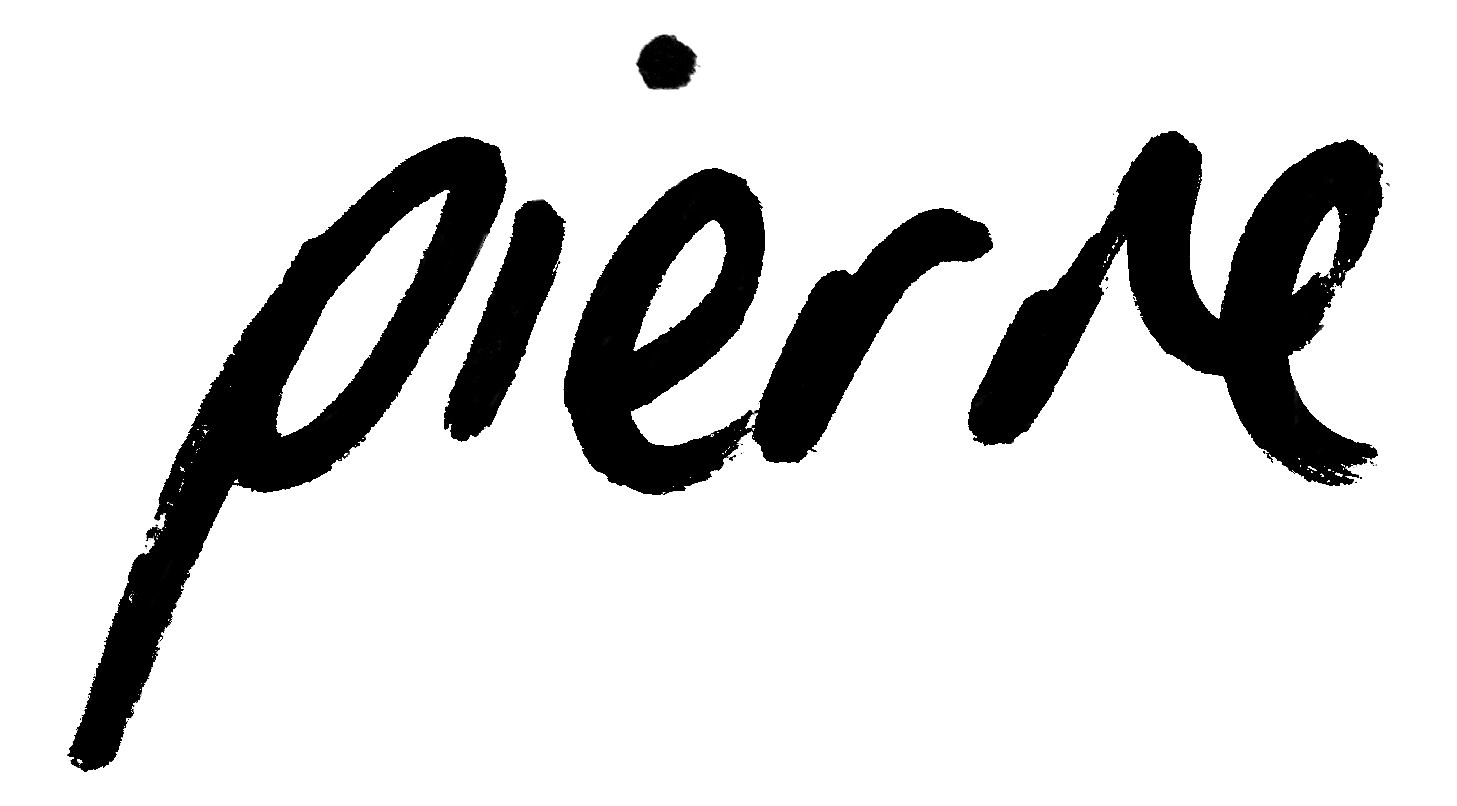
AN EIGHT-WEEK COURSE WITH PIERRE DU PLESSIS
Only the Brave
For people who sense something in their life needs to change, and want to work out what — and then actually do something about it.
Eight weeks. One question a week. Short teaching, a small daily practice, and a conversation with two other people every Friday. Most of the work happens away from the screen.
Next cohort starts Monday 3 May 2027 · Online, with three live sessions · R4,500 incl. VAT
Most of us try to answer the wrong question first.
We ask: what should I do? Which job, which move, which strategy, which next step. It's an understandable question. It's also the reason so many good decisions end up feeling strangely hollow.
Only the Brave starts somewhere else. Before what comes who. Who you are is always greater than what you do — and what you do will change many times over a life. When you know a little more about the person underneath the role, and what that person actually wants, the next step tends to get clearer. Not easier. Clearer.
The course moves through four movements:
Identity → Desire → Discernment → Bravery
Who am I? What do I want? How do I know which way to go? What will I do? Bravery is the part that turns reflection into a life. Not the absence of fear — acting while the fear is still there.
“I don't always know where I'm going, but I can learn how to get there.”
You might recognise yourself here
You're doing well by most measures, and you're not sure it's what you want.
You've reached a transition — chosen or not — and the old map doesn't fit.
There's a decision in front of you and you can't think your way to it.
You've spent years doing what was expected, and you'd like some of your life back.
Something feels slightly off, and you'd rather look at it than keep busy.
You could be 25 or 65. This isn't a midlife course. It's for anyone who has started asking what their life is for and wants a better way of finding out than another list of goals.
What this course is not
It helps to be clear. Only the Brave is not a productivity system or a goal-setting programme. It's not motivation, hype or a pep talk, a personality test that tells you who you are, therapy, or a career-planning course. It's not a religious course — it is hospitable to every tradition, and to none. It's not eight weeks of watching someone talk. And it's not a promise that you'll discover your one true purpose.
It draws on philosophy, psychology, theology, literature, film and a fair amount of Disney. You don't need an interest in any of those to take it. The ideas are there to be lived, not studied.
Eight weeks, eight questions
Each week is organised around one question. You won't answer all of them neatly. Some weeks the outcome is a better question, and that counts.
Week 1 · The Question
What do I want to do with my one wild and precious life? Freedom, drift, and the scripts we inherit. Making the question alive rather than solving it.
Week 2 · Identity
Who am I? Separating who you are from what you do: your story, your body, your people, your gifts and limits.
Week 3 · Belonging
What if I don't have to earn my right to exist? Receive before you achieve. Practices for feeling grounded, not just being told you're enough.
Week 4 · Desire
What do I actually want? Desire as information. Telling your own wants apart from borrowed ones — glory, gold and the rest.
Week 5 · The Cave
What am I afraid of? Fear, the inner critic, the ways we make ourselves small. Acknowledging the frightened voice without handing it the wheel.
Week 6 · Discernment
How do I know which way to go? The Examen: noticing what gives life and what drains it, and learning to read the tracks.
Week 7 · Bravery
What will I do? Shrinking the action. A three-day brave act: the next conversation, experiment, boundary or decision.
Week 8 · Integration
How will I keep living this way? Building a rhythm you take with you, so the attention doesn't stop when the course does.
Identity, desire, discernment and bravery aren't four boxes. They're movements you'll keep travelling through — the course just helps you learn the route.
The screen delivers the invitation. Your life is the classroom.
We'd rather you watched twenty minutes and spent the week noticing yourself than watched two hours and forgot it. So each week is deliberately light on content and heavy on living.
Monday — the idea. One short film carrying one story or idea, made to be watched on your phone.
Tuesday to Thursday — the practice. A small daily activity: a walk with an audio prompt, a page in your notebook, something to try or notice at work or at home.
Friday — the conversation. You meet with the same two people every week, in person or online. Some questions only become clear when you say them out loud to someone.
Weekend — go deeper, if you want to. Optional essays, stories, readings and rabbit holes for the curious.
Every week has three layers: Essential, the minimum to stay with the journey; Practice, something you do in your actual life; and Go deeper, for people who like to disappear down a rabbit hole.
What you'll need: a phone, a notebook, headphones, and somewhere to walk.
Try this tonight
This is the Examen, a practice about five hundred years old, adapted for the course. It's one of the things you'll return to throughout the eight weeks. It takes about five minutes.
Sit somewhere quiet and let the day play back, from waking up until now. Don't evaluate it. Just watch it go past.
Notice one moment that gave you life. Where did you feel most like yourself? Where did you expand?
Notice one moment that drained you. Where did you contract, perform, or feel like someone else?
Ask: what might tomorrow look like if I leaned, even slightly, toward the first?
Do this for a week and you'll start to see patterns. That's the beginning of discernment — not thinking your way to certainty, but learning to pay attention.
What changes
We don't promise a new life in eight weeks. We hope that at the end you can honestly say:
I notice myself differently.
I understand something about what I actually want.
I have a way of navigating when I don't know what to do.
I'm less willing to hand my life over to fear, convention or other people's expectations.
And I've actually done something.
What you take with you
A daily Examen — the habit of noticing what gives and takes life.
Your compass — a page you build week by week, capturing who you are, what you want and what you've noticed.
A future-self anchor — a picture of the person you're becoming, to steer by when choices get murky.
Your brave acts — at least one small, real thing you did that you'd been avoiding.
Two people — a triad who've walked the same eight weeks with you and know what you're working on.
The aim isn't to hand you an answer to what you should do with your life. It's to help you become someone who can keep answering that question for yourself.
Why I made this
I wasn't a brave kid. I was bullied a lot, and my strategy was to make myself very small, because small felt safe. Some of that strategy is still in me. Only the Brave comes out of a long, personal struggle to find my own way, and out of twenty-odd years of walking alongside other people trying to find theirs.
I'm a coach and a speaker, with a background in theology. My master's research was on loneliness and belonging. For years I've given this work as a keynote and at retreats, and the same thing happens every time: people come up afterwards and ask, "So what do I actually do now?" This course is my answer to that question — the keynote turned into eight weeks of practice.
I'll be with you in the live sessions. Most of the time, though, the course is designed so that you spend less time with me and more time noticing yourself. That's the point.
— Pierre du Plessis, Be Brave
Your reflections belong to you
What you write stays yours. Your notebook and private reflections are never shared — not with your cohort, and not with an employer if they're paying.
You choose what to share. Some things are private, some are for your Friday triad, and a few are for the wider group. Nobody is pushed into vulnerability they didn't choose.
This isn't therapy. Week 5 goes into fear and old wounds, gently and with care. If something heavier surfaces, a named person on our side is there to point you to the right support.
For teams and organisations
Most organisations don't have a motivation problem. They have an agency problem: safe decisions, borrowed strategies, people waiting to be told. Only the Brave works on what sits underneath that — how people decide, act under uncertainty and take responsibility for their own direction.
What it builds: agency · decision-making · courage · self-awareness · adaptability · the ability to navigate change
Cohorts start together on a set date, with each week released on schedule.
Participants work in triads across reporting lines, so nobody is in a group with their manager.
A named cohort host handles enrolment, follow-up and care, so it doesn't depend on your HR team.
Three live sessions, which can open with a senior leader.
You see participation and completion. You never see what anyone writes.
Can start with the Only the Brave keynote and follow with the course.
Pricing for teams: from R3,000 per seat, excluding VAT, depending on group size. We enrol your people for you, whether that's 10 or 100.
The details
Dates: Cohort 1 runs Monday 3 May – Sunday 27 June 2027. Cohort 2 runs Monday 26 July – Sunday 19 September 2027.
Format: Online and made for your phone, with three live sessions on Zoom.
Group: You'll be in a triad of three for the whole eight weeks.
Price: R4,500 per person, including VAT. Paid securely on Thinkific, where the course lives.
Includes: Eight weeks of films, audio and practices, live sessions, and your triad.
Questions people ask
Is this a religious course?
No. I have a theological background and some of the thinkers I draw on come from faith traditions, alongside philosophers, poets and film-makers. The course is built to be hospitable to people of every belief and none.
Do I have to share personal things with strangers?
No. Most reflection is private. Your triad conversations go only as deep as you choose, and nobody reads your notebook.
What if I fall behind?
Each week has an essential layer you can do in very little time. Your host will check in, and your triad will notice. Catching up is normal.
Will I find my purpose?
Probably not in the way that question usually means. You'll leave with a clearer sense of who you are and what you want, a way of deciding, and at least one thing done. Many people find that more useful than a single answer.
I don't know what I want. Is that a problem?
That's the most common starting point. It's exactly what the course is for.
Is it therapy?
No. It's reflective and sometimes challenging, but it's not a substitute for therapy. If you're in a difficult place, please speak to a professional first; we're happy to talk it through with you.
Can my company pay?
Yes — see the section for teams and organisations above, or get in touch.
So, what will you do?
You don't need to see the whole road. You need to see the next step, and be willing to take it. Then the next one.