Courage. Anger. Agency.
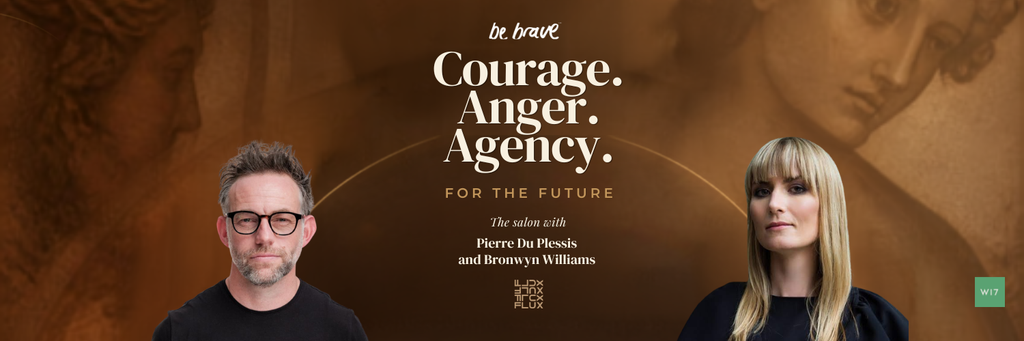
Courage, Anger and Agency: A Conversation
Pierre du Plessis and Bronwyn Williams
What follows is an edited transcript of a live conversation between Pierre du Plessis and Bronwyn Williams, held in front of an audience.
It has been tidied for reading: filler and false starts removed, garbled names and references corrected, and a few tangents trimmed. The conversation circles three ideas: anger, courage and agency, and how comfort, technology and fear of responsibility are wearing all three down.
Part 1: Are we angry enough?
Bronwyn: Let's start with anger. This is a somewhat controversial opinion, but my thought is that maybe we're not angry enough. I have an almost twelve-year-old daughter who has never rebelled against anything or pushed back against anything, and I thought I was lucky. But young people are supposed to criticise their elders and challenge what we stand for. That is how society moves forward. In your era it was raging against the machine, with whole subcultures defined against the authority of the elders. Now you get eye-rolling against the machine.
Pierre: I have to agree. I've got an eighteen-year-old and a seventeen-year-old, and neither of them is rebelling. I'm their parent. Why aren't they angry at me? I even half-jokingly offer them a drink, and they say no, they don't drink. We went to our thirty-year reunion a couple of weeks ago and spent a good while talking about how much we used to drink, and now our kids barely touch it. We don't know what to do with that.
To be clear, I'm not hoping my kids will start drinking. Drinking is just the example that struck me. It was one of the classic ways my generation pushed against our parents, and it seems to have gone out of fashion along with the pushing itself.
Bronwyn: And nobody is saying children should be drinking. The question is why they're so accepting. That would make sense if life were perfect, and it isn't.
Pierre: There's a line I wanted to quote: tradition is necessary to rebel against, and beautiful to return to. So I wonder, if there's nothing to push against, what are you actually rebelling against? Maybe the younger generation really isn't that angry. But the world feels increasingly polarised, and when you open social media there's plenty of anger. What do you think is fuelling that?
Bronwyn: It's armchair anger. We talk about armchair activism, and this is the same thing: complaining without consequence, not the kind of anger that changes anything. One reason is that life is more comfortable for young people than it used to be, which is a contradictory point, because many of them will tell you they've never been more hard done by.
We see it in elections, where young people aren't registering or showing up, even with important municipal elections coming. In Johannesburg we did a youth study with Student Village, looking at young South Africans and their relationship to politics, society, business and each other. We had some of them on a panel with us, and they were complaining that politics gave them nothing and they couldn't think of anyone worth voting for. We asked, so what are you going to do about it? Their answer was, we're going to wait for you all to retire. To me, that says you're not nearly angry enough.
Pierre: What makes you angry?
Bronwyn: People being so placid. On my way to the airport at OR Tambo, six or seven people pushed to the front of the queue because they were late for their plane. There was a whole train of them, and I didn't believe them. Why was I the only person bothered by it? Everyone is so accommodating of antisocial behaviour, and of things we should be angrier about.
Look at leadership, too. When you were growing up, a scandal was a career-ending event for a politician. Now they get a second term. We don't call anyone to account. We seem to have let go of the levers of anger, and of shame as well. Are those useful? As you say, they're the grist in the mill, the friction. There's a lot of writing at the moment about how our lives have become too frictionless. Not perfect, but we no longer deal with the friction we used to, whether that's letting a shopping bot decide what to make for dinner or anything else. It takes away a lot of our agency, which we'll come back to.
Pierre: The frictionless world interests me too. I was speaking this morning to a woman who had got really angry in a meeting with some of her employees. She said she didn't want to be like that, and that if she took the next-level role she'd have to be angry all the time to get people's work done, and that would be very difficult for her. And my response was: Nietzsche. (Ten minutes in, and we've already quoted him.) For Nietzsche, the will to power, your true self, only expresses itself in opposition to obstacles. It needs something to push against before it can assert itself. In a frictionless world that will to power never comes forth, which is very comfortable for people who would rather nobody rebelled against them.
I remember someone saying during apartheid that you can't take everything away from people, because then they have nothing to lose. The flip side is that if you have too much to lose, you won't rebel, because there's too much at stake.
Bronwyn: That makes a lot of sense, and it goes back to our youth research on voter apathy. The obvious assumption is that young people don't vote because things feel hopeless, unfair, and meritocracy isn't working. But when we dug into it, the real reason was that voting might disrupt the good deal they already have. It wasn't worth risking what they'd lose by trying something new. A sense of comfort was driving the apathy, not the hopelessness you would assume if you only listened to what people think they want. It isn't that things are too hard to try. It's that things are just comfortable enough.
That reminds me of the robots. We got thirteen minutes in before AI came up.
Pierre: Thirteen minutes before I mentioned AI.
Bronwyn: And it matters here, because automation and AI promise to give us everything and remove all the friction, including the friction of having to do anything at all. You have people like Elon Musk talking about universal basic income, a universal basic lowest common denominator of satisfaction, which is very reminiscent of what's already happening in South Africa. We have one of the largest societies in the world dependent on state grants. We know the statistics: more people depend on the state than contribute to the fiscus. That is another form of placation. It isn't even the temptation of luxury or greed. It's the temptation of just enough security, and it feels too risky to let go of it.
Pierre: This connects to Thomas Sowell, and it's the kind of thing we can say here that clients wouldn't want us to say on their stage. Sowell is a legend, an African American economist who has written a lot of books and is still writing in his nineties. He's a big supporter of the free market. His argument is that the main problem for the Black population in America isn't legacy oppression or slavery but the social reforms introduced in the 1960s, after Martin Luther King Jr. He doesn't say the civil rights movement was wrong, or that what came before was right. He says the type of reforms the government instituted afterwards caused the decline, because of the handouts. What I love about him is that he's interested in results. He tracks single-parent families, income, education levels, and shows them falling after 1960.
It becomes a tricky conversation, especially for South Africa. If you want to fix the inequalities of the past, how do you do it? Through grants and handouts, or another way? For Sowell, the freer the market and the more access people have to it, the more people will uplift themselves. Whether you can ever have a truly free market is another question. But I'd say that if you try to remove the friction, you rob the person of their own agency. I've seen that in my coaching work, where people were placed in positions because they had the right social profile, and it harmed them more than it helped. They ended up with severe trauma or burnout because they'd been put in a space they weren't equipped for. It's tricky.
Bronwyn: We can take that out of politics and economics and put it into generational theory. You may have seen the latest findings that people born after the 1990s are, for the first time in human history, not matching the intelligence, literacy and numeracy of the generation before. It's the first time a new cohort hasn't been smarter, taller, stronger than the last. Why? University admissions teams say cohorts can't read a whole book. Publishers tell us they can't publish books without dialogue, because readers only read the dialogue and can't follow the bits in between.
A lot of that comes back to how we started teaching and parenting. We had gentle parenting, indulgent parenting, helicopter parenting, and what my business partner Dion calls lawnmower parenting, where you mow down every obstacle and flatten the path for your children. Parents now come to job interviews and interfere in their children's friendships. It has produced a weaker generation, and not just in numeracy and literacy but in emotional intelligence, self-reliance and self-confidence, all traits that were improving with every generation globally and are now breaking. The Economist and the Financial Times have some compelling charts on it. When you're left with only easy ways, you don't develop the muscles. It's like the gym: muscle grows through small tears, through pain.
Pierre: You are what you endure. Nietzsche said he wished suffering and sickness and the worst of it on the people he loved, because endurance is the only thing worth anything.
Bronwyn: Doesn't that apply to you, Pierre, who has just finished a master's degree in loneliness, of all subjects? Isn't that partly why people are lonely? Every relationship you will ever have ends in pain, through death, divorce or alienation. Is that why people avoid relationships? You protect yourself from pain, but you lose all the pleasure that comes from the fragility of connection. You don't get a dog because you know it will die before you. You get the dog and you love the dog.
Pierre: That's a really interesting question, but it didn't show up in my research. People are lonely for other reasons, and increasingly so, which is devastating. One of the most interesting findings is that lonely people are more likely to vote for extremist and populist parties. Lonely people are angry. The lonelier you are, the more anxious and unsociable you become, and the angrier at the world.
I don't think people are lonely because they're afraid of relationships. I think they're lonely because society no longer values relationships and friendships, and the structures that used to counter loneliness are falling away. Living in a city is hard, because most people rent and nobody can afford to buy in Cape Town. You're probably living next to one of hundreds of Airbnbs in every square kilometre, so there's a transience that makes forming relationships difficult. You work remotely, often for a business that isn't even in South Africa. Church, Rotary, the Lions Club, the local bowling club, all the traditional structures, especially the ones men used to rely on, are fading or out of fashion. Add rising city costs and remote work, sprinkle social media over the top, and you have the perfect recipe for loneliness. That makes people angry and anxious, and then they vote for populist politicians.
Bronwyn: It's a vicious cycle. So my initial contention is that in some ways we're not angry enough, and in others we're far too angry. There are more hot wars right now than at the peak of the Second World War. How do you tell the productive anger, the kind that links with courage to change things and pulls you out of apathy, from the destructive kind? Like most things, the cure and the poison are the same, and it comes down to the dose.
Pierre: How do you distinguish righteous anger? Think of Jesus making a whip of cords. I always love that detail in John's Gospel. How long does it take to make a whip? Imagine him sitting there, taking his time, and everyone around wondering who this guy is, making a whip. When people ask "What would Jesus do?", getting angry and making a whip is definitely on the menu.
Righteous anger is driven by righteous motives: bringing good and change, fighting what is evil and what keeps people apart. In that scene, the reason for the anger was that people were being excluded and kept apart. They needed to be brought together, because connection is the ultimate goal. So motivation is what counts. Aristotle would say you have to do the noble thing, for the right purpose, at the right time, which in his thinking meant what is good for the collective. And in the end, anything is measured by its results. What did your anger actually accomplish? Did it make the world better? Did it make people wealthier and healthier, or help them love each other a little bit more?
Part 2: Courage
Bronwyn: Which brings us to courage, and to the quotation that started this whole conversation. Augustine, who Pierre quotes a lot, said that hope has two beautiful daughters, anger and courage. Anger to see what is wrong with the world, and courage to do something about it. You have to overcome inertia to bring about change, otherwise you just sit around complaining, which is eye-rolling at the machine. So, Pierre, how do you define courage? I think people have a lot of misconceptions about it.
Pierre: There are two parts to it. Courage is a state, and bravery is action. There are different ways to talk about courage. The one Brené Brown made famous is that the word comes from the French cœur, heart, so it means exposing your heart and being vulnerable. But there's a more demanding idea from the philosopher and theologian Paul Tillich, in his beautiful, extremely dense book The Courage to Be. For Tillich, courage is affirming your own being in the face of chaos, while you navigate the fog of life with little or no information. It means acting in spite of the fear. That's the most basic definition of courage and bravery.
Bronwyn: Pierre has a flagship keynote on being brave, and he's running a whole retreat on it this weekend, so I'm going to lean on you heavily. Do you walk your own talk? When was the last time you were actually brave?
Pierre: I'm being brave right now, sitting on a nice comfy chair. (Laughs.) It's an interesting question. I think Emerson said the bravest thing you can do is to be yourself in a world that constantly tries to make you something else. For me that's a daily act, especially in this work, where sometimes you stand in front of an audience and say the thing that needs to be said.
I was in a room recently with a member of the Ackerman family in the front row, and I had a story about Pick n Pay and Checkers that I could have left out. I saw him before I started and thought, do I tell it or not? I told it, and in the Q&A he went after me, arguing that they had been right and why they'd done what they did, and I had to defend myself on stage. It's a small, silly example, but it's about affirming yourself. In any given moment I can choose whether to rely on myself, to be myself and say what I need to say, or to go with the power in the room. That's the question we all face every day.
Bronwyn: That's easier said than done. You have two children, and many people here have children they care about, whether their own, or nieces, nephews, grandchildren. How do you raise brave children in a world that doesn't always reward bravery, at least in the short term?
Pierre: You don't mow the lawn for them. You help them take responsibility for their own actions. You help them deconstruct the world for what it is, and then you ask them to make a decision to affirm themselves in the face of it. More than once we've challenged our kids to disobey unjust rules. If there are rules at school that you believe are unjust, you don't have to obey them. My daughter has got some of her school's rules scrapped or changed because of that. Her argument was that these were unjust things, and unjust things shouldn't be obeyed.
Bronwyn: And sometimes you put challenges in front of your children on purpose. I know you did a whole initiation with your son.
Pierre: Definitely. I think that's especially important for sons, and perhaps in a different way for daughters. Our culture has lost its initiation rites, especially for men. A friend's son, who is now twenty-three or twenty-four, lost his father to an overdose a couple of years ago. His father was an addict, and he was never really fathered or initiated into what it means to be a man. Those rites are something we've lost collectively, and as a family we chose to create them again. We made a different one for my daughter and a different one for my son.
For my son, when he turned sixteen, we had him hike up Table Mountain by himself. I took him part of the way, said a prayer, and sent him on his way. Then I raced round to the other side and went up in the cable car, and we waited for him at the top. I could track him on his phone up to a point, and then for two hours I couldn't. I just saw the last place he'd been, and then he was gone. I thought, oh shit, what have I done? The danger was real. And the trick with any initiation is that the danger has to be real. If it's fake, it's not a real test of bravery. A cold plunge is not dangerous. Nobody is going to die or get kidnapped. A real initiation needs a real sense of danger.
Just last week he did another one, more facilitated, with a group of friends. Six boys spent a week in the Cederberg. When they arrived, the facilitators took their sleeping bags, and they had to build a shelter in the mountains and sleep in it. All they got to eat each day was two little ration cubes and half a cup of soup. He called it mud soup. They had to learn to survive. It was less real danger, but still a proper struggle, and you need that. One of my favourite pastors, a burly-haired guy from Oregon, always says that when there's an easy way and a hard way to do anything, you choose the fucking hard way. That's how you build bravery over time. You test it.
Bronwyn: It's about bravery and perseverance and character, for a world that increasingly doesn't want you to have them. Every company would much prefer that you just click and buy, and Amazon would love to take all your friction away. So I threw some terms at Pierre in preparation for this, and one is Moloch, or Moloch games. It's a dramatic way of talking about the prisoner's dilemmas we find ourselves in as a society.
A great example is the SEO game. We want more people to visit our website, so we pay someone minimum wage to write lots of poor copy and stuff it with keywords. Everyone else does the same, so if you don't, you fall behind. You end up in a nonsense game that really only benefits the search engine. Try finding a banana bread recipe and you have to wade through two thousand to twenty thousand words of keyword-stuffed text, because that's the only way the recipe writer can attract advertisers and afford to keep her site going. Everyone does it, and nobody is happy. She doesn't enjoy writing it, you don't enjoy scrolling past it. They even put a little button on that says "Jump to Recipe."
Pierre: It's ridiculous.
Bronwyn: We all play along, and it's very hard to break out. Same with brands and performance marketing. You have a rand to spend on building your company. Do you invest it in a room like this, talking to people and building relationships, or do you give it to Facebook, because they promise 150 back for every rand you spend on some AI-generated ad? And we all do it, because it's so hard to break the cycle.
The classic economics version is the prisoner's dilemma. Pierre and I are both arrested for saying something the thought police don't like. They put us in separate cells and offer us the same deal: if you rat on your friend, you go free and he gets ten years. If you both rat, you each get five. The rational choice, according to game theory, is that everybody rats on everybody, even though nobody really wants to. You have to be very brave to break out of those games.
Pierre: How do you do it, Bronwyn? How do you break out of those games?
Bronwyn: Not very successfully. But how do you actually develop the grit to go against the stream? We've said you start with your children, by not mowing the lawn. How do you do it for yourself? You coach people on this, and you're running a retreat on how to be brave. How do you teach people to make that sacrifice?
Pierre: The trick with taking the leap, or being brave, is that you need a third party outside yourself that can hold your weight. You cannot be brave alone.
Søren Kierkegaard, the existentialist philosopher, wrote in his journal at twenty-two about what truth is strong enough to rest his weight on. When you get to the edge of the cliff and have to take the leap of faith into the unknown, you need something to stand on. Paul Tillich calls it the moment you have to affirm yourself, and all of this is really about identity, about opening yourself up and being vulnerable. The world is pushing you in a direction and trying to make you something you're not. There are plenty of brands and leaders and people out there who are very happy to tell you exactly who you are and what to do with your life, your business and your money. If you don't know who you are, and don't have the courage to affirm it, they will.
So you need something you can rest your weight on. For Kierkegaard that was his faith, which is why he called it a leap of faith. For Tillich it was what he calls the ground of being. Imagine the bottom of a dark lake. We're all trying to survive and not drown, but the way you save yourself is by letting go, sinking all the way down until you hit the bottom, so you can push off it toward the side. Tillich's question is what that bottom is, and for him it's being itself. If you affirm your own being, you have something to push against in order to take the leap and do what you need to do. But you can't do it by yourself. That's the catch.
Bronwyn: At a more prosaic level, that reminds me of conversations I've been having about business. What is business, other than a lot of people making choices together? We hide behind the supposed amorality of the free market, but companies are made up of people who have values, who have a bottom, who have people they're accountable to, and mirrors they look into, whether that's family, children or spouse.
For a long time we've tried to delude ourselves that values and price are the same thing, and this is a spicy take, but they are not. A lot of economists and consultants have argued that democracy will get you economic growth, or that if you invest in diversity, equity and inclusion, or in ESG, your profits will go up. There are plenty of Harvard Business Review op-eds telling you that putting women on your board will lift your share price. The problem is that this doesn't check out in the real world. Some of the fastest-growing economies in Africa are run by quite authoritarian regimes, and the Asian miracles were achieved through centralised control rather than democracy. Over the past few years, and especially since the latest Trump administration, the correlation between investing in DEI and ESG and shareholder value has come apart.
That's not to say we shouldn't invest in democracy, diversity, equity, inclusion or ESG. It's to say that investing in them because you believe you'll get a financial return is a brittle value, not a resilient one. Many lovely South African companies have published op-eds and run adverts about their values. But when those values start to diverge from market forces, are you brave enough to stand by them?
Pierre: That's such a great question, and I love it. It's the same decision any of us face. I was at a family business conference recently, where the average revenue of the businesses in the room was a hundred million dollars or more. These were South African family businesses in their third, fourth and fifth generations, some really scary in size. A woman in the Q&A said that in the community her family comes from, there were businesses operating that were raping the land, disrespecting the community and abusing the people there. She asked whether I thought businesses like that would continue to exist in the future, and whether people would keep supporting them.
I said yes, definitely, for a couple of reasons. They want the money and the economic growth, and that's the quickest way to get it, legally or semi-legally. And on a deeper level, there is evil, or chaos, in the world that wants to pull things from order back into disorder. So the question isn't whether those companies will continue to exist. The question is what you will do, as a family business with quite a bit of influence, in the face of that. That's the question in front of everybody. Martin Luther said, here I stand, I can do no other, at risk to his own life. That's what bravery and courage is.
At the same time, one of my mentors always says that if you want to make money, stop being in business and sell drugs and guns, because it's much easier. But that's not what we want. We're moral beings, hopefully, and we want to create something a little bit better. So what is the motivator?
A friend of mine, an IP lawyer, was telling me recently about the debate over giving AI legal rights. She suspects Japan will be the first to give rights to an agent in the way a human has rights, because companies already have different rights there. In Japan a company has honour, and you can be sued for attacking it, the same as you could for defaming a person here. That's maybe a separate conversation, but it shows how differently different cultures think about the values of a business.
Part 3: Agency, free will and the machine
Bronwyn: Let's change the subject and go back to AI. You brought up agency for AIs and rights for robots, and I gave you some homework: are you afraid of Roko's Basilisk? Maybe explain to the audience what it is.
Pierre: I did my homework. Does anybody here know Roko's Basilisk? I have to ask your permission before I tell you, because once you hear it you can't unhear it, and you'll be held responsible for what you do afterwards. It's a thought experiment. Are you ready to risk your life on the basilisk?
Suppose that in the future there is an extremely smart AI, the AI to end all AIs, omniscient and omnipotent. It can reconstruct all the lives that have ever existed and work out who helped to create it and who didn't. Then it looks back into the past and says, that person over there did not help me, so I'm going to clean out their bank account and punish them and their descendants for all time. The question in front of you is this: knowing that, will you from today help to create this AI, in case it ever exists?
Bronwyn: This is a thought experiment that is said to underpin a lot of Silicon Valley thinking, and Elon Musk and Grimes famously bonded over a joke about it. It leads into the third pillar of our conversation, and probably the most important one, which is inevitability. The point is that the future is predetermined and you're either for it or against it, history is moving on, and either we have free will to resist the superintelligence, or everything is predetermined and will fall into place. I know you speak about free will and agency a lot. So draw the line in the sand. Do you actually believe in free will, and if so, why? I know you have theological training.
Pierre: No theological training. Without free will, there can be no love. You can never force somebody to love you. I've tried. No matter how many presents you send or how hard you try to make it work, it doesn't work, and forcing it tends to have the opposite effect. That's one reason I believe in free will.
I also believe in it because it's our lived experience. I often argue with hard determinists, which seems to be very in vogue at the moment, people who say everything is just caused by what came before. To me that idea is nonsensical because it's nobody's lived experience. Your experience is that you have some control. Of course we are all influenced by factors outside our control, by our genetics, the luck of our birth and where we grew up. But that doesn't fundamentally remove our free will. If you sit down, reflect, trust your gut and choose, you can still make a decision.
I think we have clever ways of escaping our free will by saying we don't have it. One is simply saying "I can't": my genetics, my intelligence, the inferiority of my birth. (If you know the reference, we can be friends forever. It's Pride and Prejudice, people.) The opposite is what Kierkegaard called the despair of the infinite, where you escape into a dream world of abstraction. There are always ideas and theories and philosophies, but you never take any action. And not believing in free will is itself a way to escape it, a way to remove responsibility. That's my pet peeve at the moment, because I work with a lot of founders. When I ask why they're entrepreneurs and take these massive risks, they say, "Because I want freedom." I say, you have freedom right now. "No, I want a yacht, I want to travel when I want." You don't want freedom, you want luxury, or you want not to be responsible, because freedom is being responsible. Sartre said we are condemned to be free. We are condemned to pick up this responsibility. People avoid their own terrifying agency because they would be held responsible for their choices.
Bronwyn: Which goes straight back to why countries like Japan are so interested in giving rights to AI, and why we're so keen to believe in the sentience of machines before we believe in our own. How many avowed atheists who believe entirely in determinism are also happy to believe in the sentience of robots they've built themselves? Why is it easier to believe in the freedom of machines than our own? You've answered it. Accepting freedom means accepting responsibility. True freedom is not freedom from responsibility. It's the freedom to choose the responsibilities you take on.
Pierre: Freedom to take up your responsibility. I made an argument in a talk recently: what if there were an AI you could outsource everything to, and it was completely benevolent and would only ever do the good, right, noble thing? Would you do it? The counter-argument is that AI will probably give you the average answer, so if you're below average you should definitely outsource your decisions to it. There are a couple of people I've worked with where I think, please let AI make all your decisions, you'll be so much better off. If you think of the average person and how frustrating they can be to deal with, half of people are worse than that. If we could just get the bottom half up to average, it would lift everything. So maybe it's not such a bad idea.
But people who are happy to trust the robots still need a third thing. They need a ground of being, something they can rest their weight on. I think that's how humans are put together. We need something outside ourselves to trust so that we can move forward, and for lack of anything else we say, here's this omniscient AI, I'll hand my agency over to it.
I saw someone talking the other day about how he had given an AI access to the cameras in his home and to all his medical data and tests. The AI noticed he wasn't sleeping well. It noticed he was dehydrated and told him to drink a glass of water. He filled a glass, the AI saw it on the cameras and sent him a little reward, and he said he felt really proud of himself. I was listening to this thinking, what the actual hell. Then he said that while he was driving his Tesla on autopilot, the AI logged into the car and changed the route to take him to a pharmacy to buy magnesium supplements, because it had decided he needed them. And he said, "How great is that?" I thought it was the most frightening thing I'd ever heard.
Bronwyn: But that's the crack in the whole conversation. We opened with the premise that agency is worth investing in, and you've already conceded that if you're below average, maybe it isn't. And that man with the AI cameras is being very well looked after. He's hydrated, he's feeling great, and he's safe. He's not driving drunk, because Tesla is driving for him. Society would be a lot safer that way, and let's face it, we live in South Africa, where society could be a lot safer. Safety is a very powerful lever. Given a choice between knowing your children will be safe, protected and comforted, and knowing they'll have a hard life full of pain, suffering and risk, isn't the rational choice to cede agency wholesale to a benevolent AI basilisk?
Pierre: There's so much I want to say. It feels like you're interviewing me. Safety is not a virtue. The four cardinal virtues are prudence, justice, temperance and fortitude, which is to say courage, and the three theological virtues added by Christianity are faith, hope and love. Safety isn't on either list. We've made it into a virtue, but it never was one.
There's a conversation with everybody's favourite at the moment, Peter Thiel, who argues that the world isn't innovating fast enough. It's only innovating in a thin sliver of the digital, while the physical world looks largely the same as it did thirty or forty years ago. He uses the image of sailing between Scylla and Charybdis: on one side the whirlpool, unfettered innovation where you take off all the guardrails and let it rip, and on the other the monster, regulation, where you put guardrails on everything. His argument is that we're veering far too close to the second. It now costs a billion dollars to develop a new drug, and the legal drug industry has stalled, while the illegal one is thriving. To solve the problems the world faces, whether environmental, political or health, from cancer to longevity, he says we need to lift regulation so people are incentivised to innovate faster.
Bronwyn: The Mexican drug cartels are setting up shop here because we have regulations but not enforcement of them.
Pierre: Right. Whatever you make of his argument, safety has never been a virtue. And other people's safety surely serves some people's agendas. Nineteen Eighty-Four is a good example.
Bronwyn: Given a vote, how many people would honestly choose safety over freedom? Freedom is a hard sell. That takes us back to whether democracy is a good ideal. If the majority want a safe, genteel future instead of a scary, hard, free one, how do you reconcile that?
Pierre: I don't know. It's a really good question. It reminds me of that line in Gladiator: Rome is the mob. Give them bread and circuses, show them slaughter and they'll love you for it, and they'll turn a blind eye while you do whatever you want. Or Loki in the Marvel films, when Marvel was still making good movies, saying people want to be ruled. There's some truth to that, I suppose.
Bronwyn: You speak a lot about hope. What's the intersection between hope and agency? Is there a way, by throwing hope back into the ring, to stop us selling our freedom to a world that's looking for safety?
Pierre: A friend of ours wrote a book called Hope Is a Strategy, and I really do believe that. Hope is a value and a virtue, but hope without action is just a wish. We don't only wish for a better future. Hope is about action, about making the world a better place and helping everybody get healthier and wealthier. So you need action, you need free will, and you need the courage to do the right thing, the noble thing.
Bronwyn: A virtuous cycle, as opposed to the vicious ones we started with. But let me throw in a spanner. I don't know if you've read Stephen Fry's retelling of the Greek myths. He's very witty and very cynical, and he has a different take on hope. When Pandora opened the box, all the terrors flew out, and she closed it with hope trapped inside. That's usually read as a tragedy. Fry presents it as the opposite: hope is the most terrible of all, because in the face of inevitability, of the fact that we're mortal beings on a mortal planet headed for the heat death of the universe, leaving hope behind in the box was the mercy, not the curse. What's your take?
Pierre: I'm not enjoying being interrogated. This is horrible. Stephen Fry is wrong. Anybody who has read Sandman knows that hope defeats chaos and order and the end. Everyone's favourite atheist, I see you, Stephen Fry, and I raise you Neil Gaiman. Hope trumps chaos, and it trumps the anti-life.
Bronwyn: That's the catch with agency: everybody is playing their agency cards, and you don't get everything you want, because my freedom runs into yours.
Pierre: Which do you want, freedom, equality or brotherhood? You can only have two.
Bronwyn: I have that on my blog, a nice little triangle. It's one of history's triangular cul-de-sacs. We have to keep negotiating a balance between all three, because you can't have one without letting the other two down in some ways. That brings us to Francis Fukuyama's end of history. We find a nice equilibrium, but it isn't stable, because someone can always pull in a different direction. That constant tension and negotiation, and the anger at the way things are, is the grist that has moved humanity forward.
From a futures perspective, we are at a very interesting point, because with agentic AI, with that benevolent AI in your house telling you when to drink and when to moisturise and when to go to the petrol station, we have a choice to cede our agency and freedom in a way we haven't had before, individually and as a society. We've never been able to govern each other with technological, near-omniscient control before. Now we can.
I've been writing about what I call moments of systemic rejection: the ability to sanction someone with a piece of computer code and cut them off from much of humanity. If the US sanctions an individual, no US company can support them. It doesn't have to go through a court. It's a quiet decree, and suddenly you can't use your credit card, because Mastercard and Visa are US companies. It's complete cybernetic control, and it's very peaceful. My futurist friend Ian Pearson, one of the craziest futurists in the world, says that with current technology we could program an mRNA vaccine, like the COVID ones, to give you excruciating pain whenever you disobey whatever rules we set. He says we can do it right now, and he's trying to sell it as an idea, because that's what the crazies do. It would also undo all the good work done on vaccine hesitancy.
The point is that we have the potential to build a completely safe, completely agency-free world, and at the same time the ability to choose the opposite. If you go to a Singularity University conference, you'll hear people say we won't need democracy any more, because we can put chips in everyone's brains and get an instant consensus from every human being at any time. They are presenting this seriously to people with the power and the money to make it happen. This isn't science fiction. We are at a point where we get to choose whether to hand our humanity over to gods of our own creation. What do we actually want?
Pierre: Do you want to be the Borg, or do you want to be Starfleet?
Bronwyn: That is the choice. We don't have answers for you today. We just want to give you a chance to give us some questions.
Part 4: From the floor
Pierre: For my closing words, this is where I can sometimes agree with Elon Musk. Consciousness and awareness are a flickering light in the universe, and that light is worth protecting and fighting for. The Western value of individualism stands in tension with community and Ubuntu, but it's also something precious worth fighting for. The value we place on a single human life is something we should never disregard. That's what we need to stand up for, affirm ourselves for, and it starts with you. Questions, comments, threats, insults?
An audience member: I recently moved back to South Africa after sixteen years away. I found it disappointing to hear Peter Thiel quoted, because of remarks of his about misogyny. It's also hard as a parent of American kids who are being influenced by this. I'm not asking you to be a politician, I'm just making a statement.
Pierre: I don't agree with everything Peter Thiel says, but I do agree with some of what he says, so I prefer to discern between the things people say. Some of them are still valid to me, and I still quote them. But thank you for saying that.
A former ad man: There's a great anecdote from the 1940s about Betty Crocker cake mix. They made an amazingly simple mix, so easy that it should have been a hit, and it blew up at first, and then sales slumped. They realised there was no friction, and therefore no satisfaction. So they changed the recipe to say "add an egg," and sales went up, because people were suddenly making something. There was agency, and pride in their work. Nowadays it's called the IKEA effect.
We edit hundreds of videos, thousands over time, and it's always been a very manual process. We've started using AI. A video recipe that used to take two or three weeks, we did this morning in about fifteen minutes. Three people on my team are looking at this with big eyes, wondering what's actually going on. A mate of ours using AI across his business has seen output go up by some insane margin, and a second-order consequence has emerged: a flatness in the organisation. It's a lot easier to do the work, but the friction is gone, and so is the pride. It's the Betty Crocker effect. We need to throw the egg back in. Is there something we can see in the trajectory? The motor car created far more jobs than it took away. Or are we headed for an emotionless, prideless future of people with sippy cups watching whatever's in front of them?
Bronwyn: I wrote a book about that, so you can get it outside. There are two answers, and it isn't as clear-cut as it feels. It depends on where you sit, and the question for everyone is how you get to be the egg again, rather than the cake. On one hand, yes, more jobs will come about. It's a well-known economic effect that when something gets cheaper, demand increases. About three years ago, lots of people on lots of stages said radiologists would be the first to go, because AI can spot a cancer more easily than they can. What actually happened is that AI was rolled out, scans became cheaper, doctors prescribed more of them, and there are more radiologists than before.
But that doesn't solve your problem, because the radiologist's job has changed. It's now a checker's job, not an authority's job. We call that deprofessionalisation. You're subordinate to your machine boss rather than the boss of the machine, and that takes away a bit of job satisfaction and a bit of status. Then we have to find another source of self-worth, because our self-worth and status are so tied up in our job and title. Is that really so bad? Job status is arbitrary anyway, and if our satisfaction comes from being superior to someone without our title, should we lose sleep over losing it?
The way out is the difference between value and price. Companies need to ask whether they'll back their values when there's no price attached, and we have to do the same for ourselves. Do you value yourself for yourself, or only for your price and your status in the market? That's a much harder question, and it comes close to Pierre's work on loneliness and self-esteem. The light answer is that there will be work for lots of people and the economy keeps moving. The harder answer is what I call musical chairs. Every time the music stops, everyone scrambles to find a chair, and there's one fewer. There's still time. This isn't something I expect in my lifetime or even my daughter's. But every turn of the dial makes us think harder about our real, intrinsic value to ourselves and our communities. And you need to be very clear that the work you're doing isn't bullshit.
At a conference where we were talking about AI and the future of work, a young woman who had just graduated after four years of studying to be a video editor came to me in tears. She said, "I've heard you, but you need to tell me a different answer," because I was telling her that what she'd studied no longer had value in the marketplace. I couldn't tell her she was wrong, but I could tell her she can change her perspective. She won't be paid what she thought she would, because someone can now do it cheaper, and that someone isn't running a charity. But if you're no longer employable by someone, how do you become the employer? Maybe your boss doesn't need your job, but you don't need a boss to be paid. You can use the same tools to get access to markets and capabilities you wouldn't have had before. But first you have to let go of the bar in order to find out what comes next. There are no easy answers.
Pierre: This reminds me of something Nick Cave said about AI never struggling. Humans create through pain, through some kind of trauma that we put into art, literature and music. Cave's argument is that songs arise out of suffering, and that an AI, having been nowhere and endured nothing, is condemned to be a soulless imitator. What it makes can be beautiful, but there's no pain or suffering in it.
Woman who runs an education organisation: I work with young people from very high-friction environments, with no money and families who have none, who get access to an incredible opportunity. We're assuming a lot of friction in this conversation, but this room has a lot less of it, look around. That isn't the context Africa finds itself in. Our young people travel ninety minutes a day to get to school and back, get up at four in the morning to study, and carry a huge load. They're angry about a lot of things. When they ask me to mentor or coach them, I say no, I'm a privileged Canadian woman with a completely different education and picture of the world. Find someone in your own context that you can look up to. How do we understand the context of Africa, and of South Africa, where the youth are overwhelmingly Black and not like us in this room?
Bronwyn: I think there's an answer in what we've been saying, though perhaps we didn't spell it out. Friction is the gift. It isn't the underprivileged who are disadvantaged here, it's the comfortable. That's the framing we can teach children who don't come from frictionless, overdeveloped parts of the world: the friction isn't a handicap, it's your advantage. You can see it in the statistics on optimism, which is highly correlated with lifetime success. Optimism among young people in the so-called Global West, in the Americas and Europe, is the polar opposite of optimism among young people in Africa and Asia. A lot of that comes down to what you have to lose. When you start at a deficit you have nothing to lose and you only see the gain in solving problems. If you start with a diamond, you get what I described earlier with elections and apathy. South Africa isn't particularly privileged, but it's more privileged than many other parts of Africa, and a lot of our apathy, and our much lower voter turnout than Ghana or Kenya, comes from our degree of comfort. Who's hungrier? Who feels they have something to gain, something to solve, and the grit to do it? That could be the frame for the children you work with: your friction is your superpower.
Pierre: You are what you have endured, and that is a massive part of your story and your gift. In my talk Only the Brave I talk about identity, and how a big part of it is our story, our continuity of consciousness, which is partly what we've suffered. Your vocation, the gift you bring to the world, is always deeply connected to what you have endured. I see South Africans working internationally, and when the South African CEO arrives, they float to the top, because South Africans work damn hard. We don't have a health and safety net. Even in this room, which is wealthy and in the top one or two percent, my daughter has friends in her year who want to study medicine, and they're told only two white kids will be taken. The level a kid has to reach to get accepted is insane. Comparing suffering with suffering is relative, of course. But in South Africa that's the gift, for any person, because everybody has suffered in one way or another.
What I wish for you is that suffering, because it will prove your worth, but not so that you get drowned out and destroyed by it. That's where people like you make such a difference, by helping people frame their suffering not as something to burn down the world with, but as anger that can change the world and bring about something. It's an extremely complicated topic, and thank you for raising it.
Bronwyn: But you should still be angry that there's a load that some people carry unsheltered. We should be calling out injustices and inequalities and naming them. And the best way to expose them is to succeed against the odds, because that's how you get the platform. It's not your fault, but it is your responsibility to carry it forward.
Pierre: Unjust laws.
Another audience member: You're working with Fred, from his previous life as an ad man, on getting young people to turn out in the local elections. What's the campaign? What's the messaging, with everything we've talked about today?
Bronwyn: That's a really hard one. Some interesting research just came out of MIT on the values of Gen Z. A lot of people are trying to skip ahead to Generation Alpha, which is my daughter's age, but she's twelve and isn't voting in this cycle or the next, so we have time to work on them. Gen Z values speaking up. They want to be heard, and they want self-actualisation, and what's in it for them. Those are the messages to rally around, and they're very distinct from the values of previous generations. The first question is whether I believe I've been heard, or whether you're talking at me instead of with me. That doesn't come naturally to political leaders over sixty. They're used to talking at you, which worked with humble, grovelling millennials, and works with the boomers, but doesn't work unless I'm actually being heard.
Here's another point. Look at all the parties and candidates on the menu in South Africa. Are there any you'd want your children to grow up to be like? Would any of you stand up and advocate for one of them? Even just the local ones?
An audience member: I was recently, weirdly, invited to run as a ward councillor. I'd always joked about being the mayor, because I wanted to change the game. I did my due diligence and met one of the candidates, and I wasn't impressed with his answers. I'm a political student and a student of journalism, and I thought, you can be so much better. Then I joined a Monday caucus meeting and saw how the woman running it spoke to people, and how everyone deferred to her, and I couldn't do it, so I dropped out. I want a party in this country that represents me and people like me. When I graduated in 2012, every year at school there were more mixed couples and everything was becoming more open. Now the division among young people is disgusting. Social media has given them a platform to spew hate at a young age, based on the hate their parents told them. Young people are angry at each other, not at the bigger world. Meanwhile all our legacy infrastructure is crumbling. And look at Woodstock, where poor people have been pushed out of their homes for decades as land is sold for tourist money. Now that it's affecting my generation and my parents, who want to live in their houses on the mountainside with the pool, they start to get angry. The anger is starting a little too late, and it's because it's messing with their comfortable lifestyle.
Bronwyn: What you say is exactly right, and it comes back to your question. If you want young people to vote, you have to be a leader worth voting for. And before that, let's speak honestly. In our youth study we asked young people who they look up to. The only people they named were their moms and aunts. They don't know men in their lives they can look up to. Leadership starts in the home, and we have a lot of missing fathers. That's not an indictment of anyone here, there are some wonderful fathers in this room, but there is no leadership for male children to look up to, and the same is true of our politicians, largely because older people have not called our leaders to account and have accepted them just because they're good enough. So it's not a quick fix. That is the fix, and it starts with exemplifying leadership in small contexts, in your businesses and homes, and earning trust there.
The young people in the study found that the best way to get them to trust a workplace was to put women in charge, because Gen Z was more likely to trust and look up to female leaders. That's not to say the female political leaders we currently have are necessarily worth looking up to. But that archetype, the mother figure, someone who cares about you even when you're misbehaving, and who isn't just trying to get something out of you or rule over you, is the kind of leader who will attract an apathetic generation. It seems very unfair, but it's not your fault, it's our responsibility.
An audience member, 58, with children aged 21 and 23: I'm going to defend Pierre and Bronwyn, because when I read your flyer I liked those three words: courage, anger and agency. I know there's a deep philosophical foundation beneath them, and I'm not a philosopher. But look how old we are. How do you communicate courage, anger and agency to young men like my sons, and to my nephews and nieces who went to very good schools here? It isn't your job to translate those three words into economic and social policy. That's why our politicians suck, and I know that's my job. But if you do this again, I wish you'd get more young people into the conversation, because it's about communicating with them.
Audience Member: I was thinking about how anger needs agency in order to move. I think we may be using the wrong words. People think Gen Z are angry, but they're outraged, which is different. And I wonder how we create an environment of agency and give people choices when AI is going to start treating us like kids. Do we start with anger, because it's the most accessible, and drive agency and courage from there? Where do we begin?
Bronwyn: You're a facilitator, Sarah, so you know you have to hold the silence until people speak. I'm not a good facilitator because I'm impatient. But that's what you have to do, especially with children. My daughter is impervious to all this. She's not angry about anything, and there's plenty she could be angry about. She doesn't rebel or push back. If I ask what she wants for dinner, she asks what I want for dinner. So you have to make her choose, and hold that space. You have to give people a safe space to choose, but you also have to make them choose, because you can only exercise your agency muscle by exercising your agency muscle. You expect your children to show up and vote, but their whole lives you've smoothed the way.
Audience Member: I also think it's not that people struggle to choose, but that in some cases they lack the capability. I don't know enough to pick a party. Even with dinner, the friction is that you're cooking tonight, your capability determines what we eat, and if you want to eat better you have to improve.
Bronwyn: Even better, that's the stretch goal. Start with apple pie. And what I'd add is that the jobs that are protected from AI are what I call village jobs, the jobs you could have done in a medieval village and that still exist today: your hairdresser, your priest, your court jester, the village witch, the butcher, the baker.
Pierre: The butcher, the baker, the witch. There you go. Sarah and I have jokes about witches all the time. She's the witch, and there's another witch in this room who doesn't know it yet. We're working on him.
For my kids, I did a talk on AI recently that started with the question, what do I tell my kids in a world like this? I tell them there will always be problems to solve. Are you going to be the one who solves them and adds value to the world? We're not going to run out of problems anytime soon.
Bronwyn: And we're the only creature on the planet that makes its own new problems.
Pierre: We create apocalyptic technologies, so we'll make new problems. The other thing I tell my kids is to ask why, to deconstruct. Even when they were very young, we'd go to a restaurant with a sign saying it served the best burgers in Cape Town, and I'd ask them, do you think these are the best burgers in Cape Town? They'd say no. Then why do you think he puts it on the sign? Because then people will come in. That's really interesting, I'd say. What do you think about that? So you keep asking why, and what the motivation is.
There was an experiment where people were falling in love with an AI, and then the researchers showed them pictures of the men who build AI. The reaction was, okay, hell no, now I'm not. Because they could see the guy at the other end controlling the thing. It's drawing back the curtain to show that the wizard is just a man after all. That kind of deconstruction goes a long way in helping people take back their own agency. I think that's us. There are books outside, and more coffee and chats. If you disagree, step to the front.